















Practical Sailor Tests and Reviews the Latest in Boat Ratchet Blocks
The racket block is one of the most recent innovations in the world of line-handling blocks. The most common use of a ratchet block is on smaller racing boats, where you are adjusting a spinnaker sheet or mainsheet by hand, without using a cleat. Uses on larger boats include running a line through a ratchet block when releasing the control line on a headsail furler, and for traveler control lines and genoa lead adjusters. In a search for the best ratchet block, Practical Sailor tested four ratchet blocks with on/off switches; three ratchet blocks with auto-sensing that will automatically flip the ratcheting on or off; and one ratchet block that has both an on/off switch and an automatic sensor. The head-to-head ratchet block comparison included products from top marine hardware makers Selden, Wichard, Ronstan, Holt Allen and Harken.
Shopping Sail Shape
Sailmakers put spin into more than their spinnakers, and when all is said and done, their art lies in turning flat material into a carefully controlled curved shape. The best-shaped sails-and the most expensive to build-are tri-radial shapes that are made from many smaller panels radiating from each corner of the sail. These sails have many more seams and require more sewing but allow the bias, or strength axis, of the cloth to be critically aligned. Most racers and performance-oriented cruisers opt for the cut because the sail shape can be better developed with this approach. A cross-cut and a miter-cut are both valid but simpler approaches to sailmaking. They lessen the number of panels and consequently the labor involved with manufacture. As long as the material used affords appropriate load handling characteristics associated with panel alignment, all is fine, especially for a cruising application where lighter weight and the final nuance of shape are less critical. More important than whether the sail is cross cut or miter cut is how well it fits and sets on your boat, and the sailmaker to choose is the one who will come aboard and make sure that his or her handiwork actually fits properly. If they both agree to do that, then take a close look at the detail work in their sails. Is the area around pressed-in rings well-reinforced? Are leech lines easy to operate? How is UV protection handled?
Practical Sailors 2009 Rope Clutch Review
Testers put six rope clutches through their paces on a test jig that measured line tension, line slippage, and the clutches holding ability over a long period of time. In terms of overall value and performance, the units tested were a tightly grouped field of competitors. Practical Sailor testers evaluated rope clutches from Euromarine Trading (Antal), the Antal V-cam 814 and Antal V-grip Plus; Lewmar D-1 and Lewmar D-2; Spinlock XCS and Spinlock XTS; and a prototype clutch from California-based Garhauer Marine Hardware. The search for the best rope clutch took a look at the pros and cons of employing a rope clutch for specific tasks as knowing when to clutch and when not to clutch is imperative for efficient line handling and safety.
Brokedown Palace
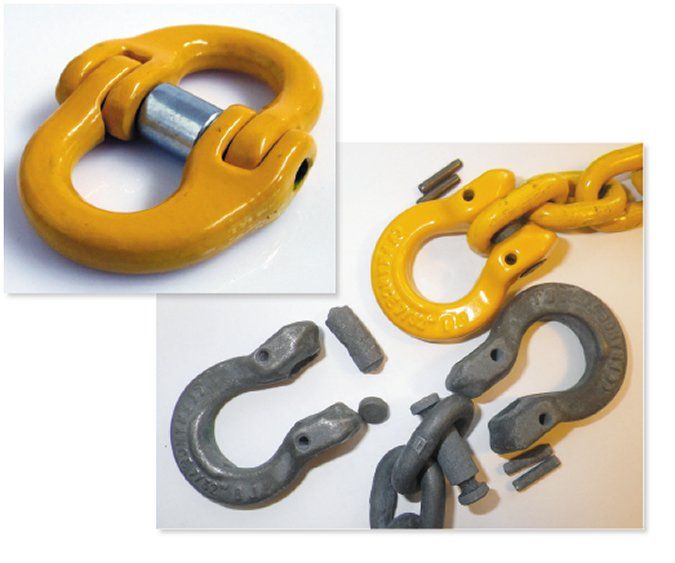
Always curious about the physical limits of sailing gear, Practical Sailor asks readers to send us their broken stuff to be studied. Interestingly, several products we received this year were made by some of our favorite manufacturers, companies with good reputations whose products Practical Sailor has recommended in the past. Digging through the "Gear Graveyard," this year reminded us why engineering a product for marine use continues to be a challenge-between the environment and the users, the odds are stacked against survival.Our electronics testing program is demanding, and the West Marine Garmin GPS 76CS Plus we recommended after our 2006 test (November 2006) had already been dunked, dropped, and sprayed multiple times before it went into service. After two more years of hard use, it failed to turn on. Corrosion at the battery compartment appears to be the cause. Although some marine electronics are rated to "water resistant" or "waterproof" standards, the standards don't cover salt water. In some respects, the designation is a bet that the user will take care of his gear.
PS Advisor: Sea Anchor Sizing
While most sea anchor manufacturers may use similar formulas for determining the right size sea anchor for a boat, other factors must be considered, including the weight of the material used in the anchor and a boat’s windage. Ultimately, what matters is that the anchor can displace enough water mass for your size boat. It’s a good idea to select a sea anchor, and then use that maker’s criteria to determine what size you need for your boat. If you have questions or concerns, contact the manufacturer for clarification. According to Don Whilldin, president of Para-Tech (maker of the Sea Anchor), the company figures Sea Anchor sizing based on a boat’s length, displacement, and type. If the result is on the line between two sizes, Para-Tech recommends going with the larger size.
Practical Sailor Tests the Alado Jib Furler
Practical Sailor finds the Alado Nautica headsail furler to be easy to install and a worthwhile sail-handling tool. One feature that sets the Alado apart from other jib or genoa furlers is its staggered slotting of five-foot foil sections that slide together and interlock over a conventional wire or rod headstay. This design allows the do-it-yourselfer to fit each foil section over an attached headstay, and simply push the formed furler up the wire or rod. Mainstream headsail furlers tend to be assembled on the ground and installed with the mast horizontal. The Alado furlers design uses integral halyards to place a compression load on the foil, eliminating the need for Loctite, set screws, and a top swivel. We tested the Alado over five months of coastal cruising and daysailing.
Heavy Weather Sailing Gear
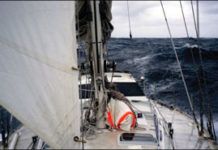
From sea anchors, drogues, and trysails to forereaching and heaving to, tactics and gear for surviving a storm at sea vary greatly. During a high-latitude circumnavigation, Evans Starzinger and Beth Leonard, aboard their 47-foot Van de Stadt sloop, had several opportunities to test heavy-weather sailing tactics. The couples main storm gear was a Galerider sea drogue, made by sailmakers Hathaway, Reiser and Raymond, is a webbing bowl with a wire hoop. Deploying the drogue involved a bridle of strong nylon lines connected to the Galerider rode via an oversized galvanized swivel. Starzinger and Leonard used the Galerider when running before the wind in gale-force conditions. The drogue helped slow the boat, kept it from surfing down the face of a wave, and provided directional stability, which allowed their autopilot to maintain control. Drogues and other storm-survival gear and tactics are particularly necessary for short-handed crews and boats that tend to surf in heavy weather. Other storm gear for sailboats that Practical Sailor looked at included the Jordan Series drogue and the Seabrake drogue.

Getting Rid of Mold and Mildew Onboard
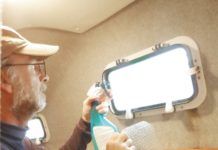
Among the marine maintenance products Practical Sailor evaluated recently were 14 pump-spray mildew cleaners to find out which one was the most effective at removing severe mildew stains. We tested chlorine bleach cleaners, chlorine-free cleaners, hydrogen peroxide cleaners, and ammonium chloride cleaners on a variety of materials, ranging from mildewed shower curtains to moldy vinyl seat cushions and moldy life jackets. We also used them to clean a mildewed sail and mildewed Sunbrella. All products were effective at removing the mold mildew from the shower curtain, but the cushions, life jacket, Dacron sail, and Sunbrella were more of a challenge. One product stood out as a more effective mildew cleaner: Klean-Strip Mildew Stain Remover. Klean-Strip is a highly concentrated product with 19 times more sodium hypochlorite than common bleach, and we do not recommend it for cleaning sails or fabrics. Other products tested include 3M mildew stain remover, Boat Armor mildew stain remover, Boatlife mildew remover, MaryKate mildew stain remover, MDR Amazons Amazing Mildew Stain Away, MDR Moldaway, Naturally Clean Mildew, Nautical Ease Mildew Stain Remover, household Spray Nine, Star brite Mildew Stain Remover, Sudbury Mildew Cleaner and Stain Remover, Thetford Mildew Stain Remover, and West Marine Mold and Mildew Cleaner.

Mailport: 01/09
In the December 2007 Practical Sailor Advisor, you requested feedback on Ultimate Sole, a product for coating cabin soles. Two years ago, I added a -inch teak-holly veneer plywood covering to my sole and used Ultimate Sole as the finish. I first put on a sealer and then two coats of Ultimate Sole. It went on very easily and performed better than I expected. It is a hard, glossy finish that truly does offer nonskid properties. You look at the finish and think you will slide all over the place, but you don't! It is a wonderful product, and I wouldnt use anything else.

Practical Sailors Heavyweight Anchors Test 2008
In a followup to the November 2008 shoreside testing of three large cruising anchors, this field report offers a glimpse of how the Manson Supreme, Manson Ray, and Rocna anchors perform in the real world. The test products, two roll-bar anchors (Rocna and Supreme) and one Bruce-style anchor (the Ray), are all acceptable as main cruising anchors. They are all good, but with distinctive strengths and weaknesses, so we tried them out, anchoring in dense kelp, soft mud, and hard rock bottoms, as well as in anchorages where short scope was required.

Why This $1M+ Sailboat Might Be The Best Bluewater Cruiser in...
The Bluewater 56 is one of the most misunderstood offshore cruisers in the sailing world — and today we’re diving deep into what makes...


Latest Sailboat Review

Rethinking Sailboat Structure
When it comes to describing a sailboats most valuable attribute, its surprising how varied opinions can be. Staying afloat should be our first priority, and although you seldom read or hear much about it at boat shows, the structural elements that hold a sailboat together are an all-important consideration.