














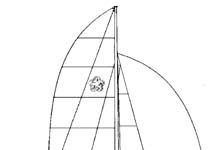
Freedom 32
An easy-to-sail sloop, this Freedom 32 with a fair turn of speed, beamy accommodations and surprising offshore capability.

Ericson 32
A look at both the 1969 and 1985 designs by Bruce King finds more to like about the later model boat.
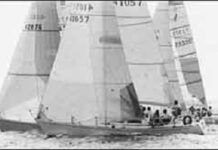
J/35
In design, the 35 looks like a typical Rod Johnstone boat, with short overhangs for a long waterline, relatively low and flat sheerline, a low cabin house, and a moderate well-balanced rig. Obviously, Johnstone knows something about the harmony between a boat's underbody and the water, but a large part of the boat's speed is also dependent on the light weight--10,500 pounds on a 30-foot waterline--as well as a good distribution of that weight.

Tartan 34
More than 500 Tartan 34s were built between 1968 and 1978. By 1978 the CCA rule was long gone, PHRF racing was beginning to surge, and the MHS (now IMS) was in its infancy. The Tartan 34 had passed from a racer/cruiser to a cruiser, not because the boat had changed, but because sailboat racing had changed. The Tartan 34 was succeeded by the larger, more modern Tartan 37, a boat of exactly the same concept.
Tartan 33
In 1978, Tartan brought out the Tartan Ten, a 33', fairly light, fractionally-rigged "offshore one design." The boat was a huge success: fast, easy to sail, and unencumbered by the design limitations of a rating rule. But the Tartan Ten had one big problem: limited accommodations with stooping headroom, an interior most kindly described as spartan. A hardy crew could take the Tartan Ten on a multi-day race such as the Mackinac, and you might even coax your family aboard for a weekend of camping out. But cruising or extended racing in comfort? Forget it!
Bristol 35.5C
The Bristol 35.5C, which also came in a full-keel version (without the "C"), is an extraordinarily orthodox boat. There simply are no extremes in design, construction or performance, unless it is in her ability to flaunt her stern downwind and burn a lot of boats when beating in light to moderate air.
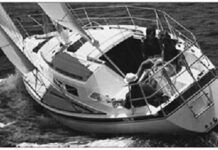
Cal 31
The Cal 31 is the thirteenth Bill Lapworth-designed Cal boat between 27' and 34' built by the Costa Mesa, California firm. Cal, a pioneer in fiberglass sailboat construction, later became a division of Bangor Punta Marine, whose boatbuilding group also included O'Day and Ranger. Cal boats went out of production in 1989. Cal and Bill Lapworth are best known for the breakthrough Cal 40, which many years ago began the trend toward moderately light displacement, fin-keel spade-rudder ocean racers.
Pearson 35
The Pearson 35 was introduced in 1968 and remained in production for the next 14 years. In all, 514 P35s were built, almost all for East Coast and Great Lakes owners attracted by the 35's shoal draft (3' 9" with centerboard up) and "classic" proportions. Even the popular Pearson 30, usually heralded as the enduring boat from a builder otherwise noted for its frequent introductions of new boats and short production runs, remained in production only 10 years, albeit with almost 1,200 boats built.
Nicholson 35
Just over 200 Nicholson 35s were built over more than a 10-year period, with production tailing off in the early 1980s. Most boats were sold in England, but a number were built for American owners, and still more found their way to the U.S. during the rampage of the dollar against foreign currencies in the mid 1980s. The Nicholson 35 is a cruising boat, plain and simple. Its proportions are about as common-sense and moderate as you can get. The boat is clean, almost austere in appearance, with very little exterior wood trim.
Niagara 31/35
Best known for his big race boats, Argentinean designer German Frers drew the lines of the Niagara 31. The 35, as noted, was drawn by Mark Ellis, who also designed the Nonsuch line, and more recently, the Northeast 37 motorsailer. The 35 came first, in 1978, and about 300 were built before its run came to an end in 1995. The Niagara 31 was built between 1980 and 1984. A less popular 26-footer also was built, as well as a 42.

Why This $1M+ Sailboat Might Be The Best Bluewater Cruiser in...
The Bluewater 56 is one of the most misunderstood offshore cruisers in the sailing world — and today we’re diving deep into what makes...


Latest Sailboat Review

Rethinking Sailboat Structure
When it comes to describing a sailboats most valuable attribute, its surprising how varied opinions can be. Staying afloat should be our first priority, and although you seldom read or hear much about it at boat shows, the structural elements that hold a sailboat together are an all-important consideration.